Consider a point source emitting radiation isotropically in all directions. By placing a spherical shells
If we assume one of the shells, say
which is the inverse square law. Now
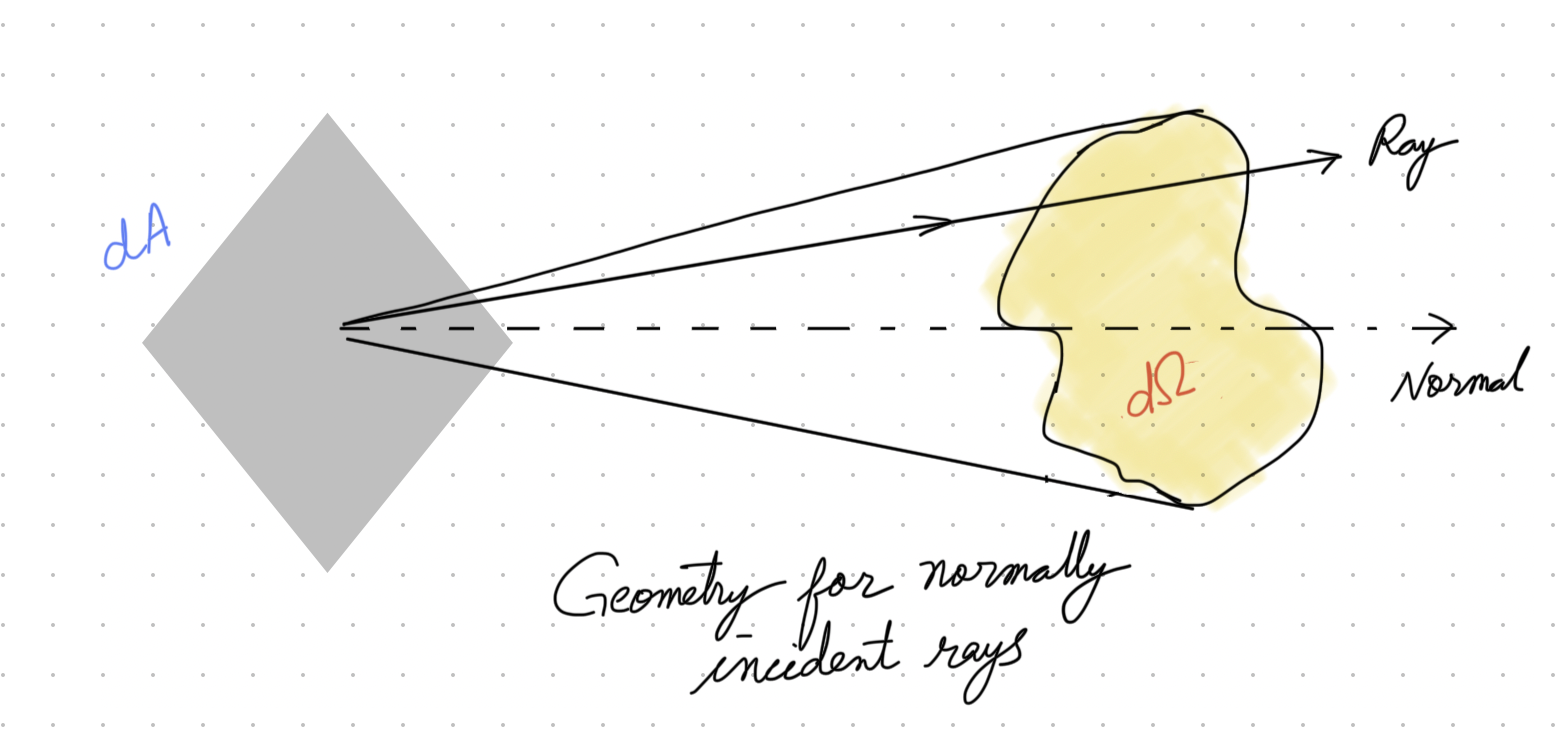
Now this bundle can carry energy as it has some cross-sectional area, which we can write as
We define
The way to understand this expression is quite simple. We want to know how much energy
- is going to cross the infinitesimally small area
, - towards direction given by
, - in time
, - in the frequency range
.
The factoraccounts for the fact that the rays do not necessarily cross the surface perpendicularly. The effective area presented to the radiation is the projected area . In particular, when the radiation is normally incident, , and the projected area is simply .
Because it gives a more detailed description of the radiation field, it is much more instructive to derive other quantities (like flux) from the specific intensity. One way to derive other quantities is to calculate the moments of
Moments of Specific Intensity
Before we derive any moments, let us write equation for
The geometrical factor can be written as
so the expression above is the same as the previous expression. More precisely, we will generally write the specific intensity as
This essentially means all the rays are aligned with
Next is to ask about the nature of the independent variable for which we will be calculating the moments for. For specific intensity, it is more constructive to think in terms of direction. From the definition, it is clear that
Zeroth moment (Radiation Energy Density)
By definition, zeroth moment of a quantity is something which is does not depend of our independent variable (direction in our case). So we want to derive the quantity which is describes how much radiation is present locally, regardless of the direction. This essentially defines energy density at that location.
To calculate this energy density, we can once again use the isotropic scenario, and imagine a point which is absorbing incoming radiation from all directions. If in time
Here we have used
The angular integral here is over the entire sphere of possible propagation directions, so
A closely associated quantity to
Consequently, we can write:
Finally, we can also calculate total radiation density
First moment (Flux)
The zeroth moment tells us how much radiation energy is present locally, but it does not tell us whether the radiation is preferentially travelling in some direction. To describe the net transport of radiation energy, we need to retain one power of the propagation direction
Recall that
From
the energy crossing the surface per unit area, per unit time, and per unit frequency is
Integrating over all directions gives us the net flux through the surface:
or, equivalently,
The word net is important here. Radiation travelling in the direction of
Thus, an isotropic radiation field can have a non-zero energy density but zero net flux. We can also integrate over the frequencies to get the integrated flux:
Second moment (Momentum flux)
Radiation carries both energy and momentum. For a photon with energy
Therefore, we can similarly ask for the rate at which radiation momentum crosses a surface.
For radiation travelling at an angle
Thus, the momentum flux is
This is called the second moment because the angular dependence now contains two powers of the direction cosine,
For isotropic radiation,
Using
we obtain,
so,
This is the familiar relation between the energy density and pressure of an isotropic radiation field. Like flux, we can again integrate over all frequencies to get:
Specific intensity along a ray
Specific intensity remains constant along a ray if there is no absorption and emission (in other words, through free space) by simply the virtue of conservation of energy. This does not mean flux is constant along a ray. Flux can decrease because the solid angle subtended by the source decreases, even though the intensity of each individual ray remains unchanged.
Footnotes
-
Note that we are trying to define
as a density function. So although, it does depend on , it is not a density function in . ↩