Blackbody radiation is radiation that is itself in complete thermodynamic equilibrium, which is a much stronger condition for system as compared to thermal equilibrium. For blackbody radiation, we have
The way to visualize blackbody radiation is simple: consider a closed cavity whose walls are maintained at temperature and let it attain thermodynamic equilibrium. In the process of attaining it, photons will be emitted, absorbed and continually exchanged with the matter (walls of the cavity). Now if we create a tiny hole in the cavity to sample this radiation, we obtain the blackbody radiation curve of this particular system.
An example of a cavity which can be used to sample for blackbody radiation is Ferry’s blackbody.
Universality of blackbody radiation
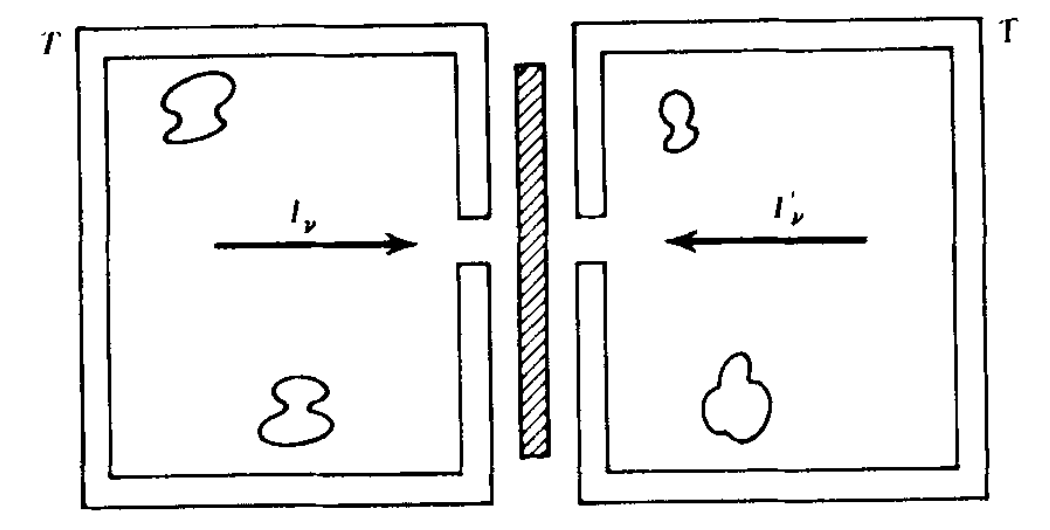
Imagine two blackbody cavities (figure below), both at exactly temperature , made from possibly different materials and of possible different shape. Assume they are connected through a filter that allows only a very narrow frequency range around to pass.
If we had then energy would flow from left to right, which would violate the second law of thermodynamics as these two are at same temperature. Thus, , which in turn implies that it is only a universal function of and . We denote this function as the Planck’s function.
If we now place some material at temperature in the opening of the blackbody cavity with emission coefficient and absorption coefficient , it must also be in equilibrium with the surroundings as if is not equal to , then this matter will start to affect the radiation intensity in the system. We already know as the condition of blackbody radiation, thus, we get following relation:
This is Kirchhoff’s law of thermal radiation. In other words, this law states, a material that is efficient at absorbing radiation at a particular frequency must also be efficient at thermally emitting at that frequency. It does not mean , but rather that their ratio equals a particular intensity.